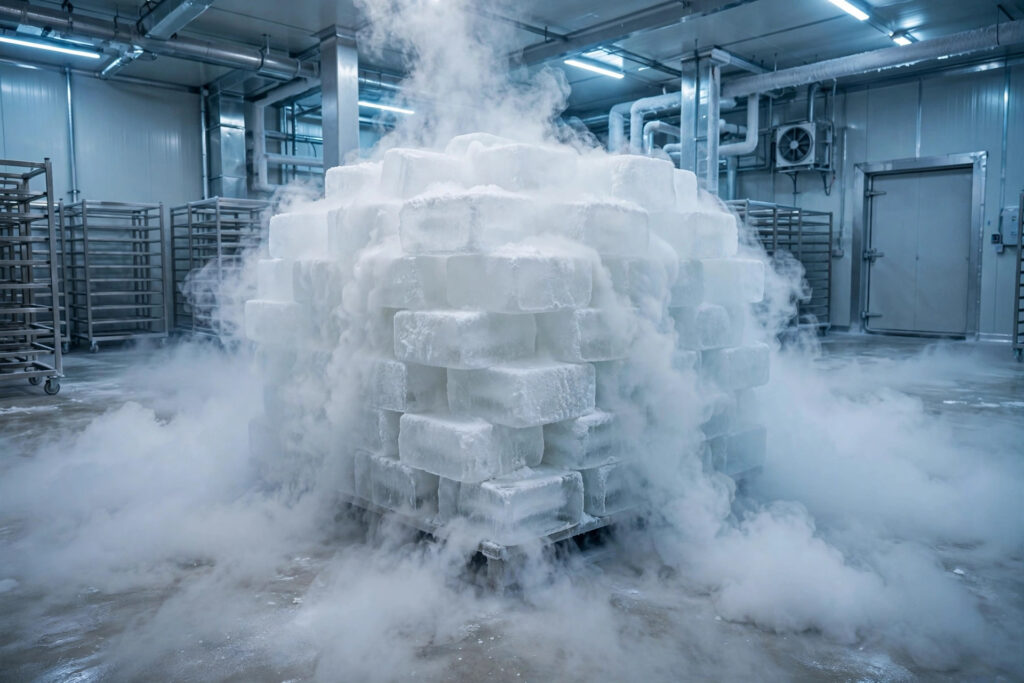
Knowing how to store dry ice correctly is just as important as buying it. Stored wrong, dry ice vanishes in hours — or worse, creates a safety hazard. Stored right, it stays useful for a full day or longer. Whether you bought a few kilos for a wedding or bulk stock for your business, these rules will help you store dry ice safely and make it last.
The Golden Rule of How to Store Dry Ice
Dry ice is always turning into carbon dioxide gas — that process never stops, even in the best container. Good storage does not stop sublimation; it slows it down while keeping you safe. Every tip below serves one of those two goals.
Use the Right Container
A Cooler or Thermopore Box Is Ideal
The best everyday option for how to store dry ice is an insulated cooler or a thermopore (EPS) box. The thick walls slow heat transfer, which slows sublimation dramatically compared to open air. Fill empty air space inside the box with crumpled newspaper or towels — less air circulation means slower loss.
Never Use an Airtight Container
This is the most critical safety rule. As dry ice turns to gas, it expands to roughly 800 times its solid volume. In a sealed container, pressure builds until the container bursts — violently. Always leave the lid loose or the container vented so gas can escape freely.
Ventilation: The Rule People Forget
Carbon dioxide is heavier than air and odorless. In a small closed room, sublimating dry ice can displace enough oxygen to cause dizziness or worse. When learning how to store dry ice, remember:
- Store it in a ventilated area — a garage with airflow, a shaded veranda, or a well-ventilated storeroom.
- Never store large quantities in a bedroom, a sealed car cabin, or a tiny windowless room.
- When transporting, keep it in the trunk or cargo area, not the passenger cabin — or crack the windows.
How to Store Dry Ice at Home
For home users — a wedding, a party, a freezer breakdown during load-shedding:
- Buy close to use time. Dry ice is freshest on day one; plan pickup or delivery for the same day you need it.
- Keep it in the cooler it arrives in. Do not transfer it to the kitchen freezer long-term — a standard freezer (around minus 18°C) is far warmer than dry ice (minus 78.5°C), so the dry ice still sublimates, and it can confuse the freezer’s thermostat.
- Keep the cooler closed except when you need a piece. Every opening lets warm air in.
- Keep children and pets away. Store the cooler where curious hands cannot reach it, and never let anyone play with it.
How to Store Dry Ice for Business
Businesses storing larger quantities — restaurants, dairies, labs, event companies — need a system:
Designate a Ventilated Storage Spot
Choose a shaded, ventilated corner of your premises — never a sealed cold room without airflow monitoring. In summer, keep the storage spot out of direct sunlight; radiant heat is sublimation’s best friend.
Buy in the Right Form
Blocks outlast pellets and slices by a wide margin. If your business can work with blocks, you will lose far less stock to sublimation between delivery and use. Break off only what you need, when you need it.
Schedule Deliveries, Don’t Stockpile
Dry ice cannot be stockpiled like normal inventory — it shrinks daily. The smartest businesses schedule frequent smaller deliveries rather than one giant monthly order. A supplier with 24/7 dispatch makes this easy.
Train Your Staff
Anyone handling dry ice must know three things: gloves always, ventilated storage always, airtight containers never. A five-minute briefing prevents burns and accidents.
Mistakes to Avoid When Storing Dry Ice
- Sealed plastic bottles or jars — pressure builds, containers can explode.
- Glass containers — can crack from extreme cold.
- Leaving it in a parked car — heat accelerates loss; sealed cabins trap CO2.
- Storing near food unwrapped — dry ice itself is safe, but direct contact can freeze-burn fresh produce; keep a barrier.
- Touching with bare hands — always gloves or tongs, even for “just a second.”
How Long Will It Last in Storage?
In a good cooler or thermopore box at room temperature, expect roughly:
- Blocks: usable for 18–24 hours or more, depending on size and insulation.
- Slices and nuggets: noticeably shorter, often under a day.
- Pellets: the fastest to disappear — use them within hours.
Bigger pieces, fuller containers, and cooler surroundings all extend these times.
Frequently Asked Questions
Can I put dry ice in my home freezer?
Briefly, yes — but it is not ideal. The freezer is much warmer than dry ice, so sublimation continues, and the extreme cold can damage the thermostat. A ventilated cooler is better.
Will dry ice keep my freezer cold during load-shedding?
Yes — placing dry ice inside a closed freezer or fridge during a power cut keeps food frozen for hours. Just do not seal it in airtight bags, and ventilate the kitchen.
How do I dispose of leftover dry ice?
Let it sublimate naturally in a ventilated area, out of reach of children and pets. Never dump it in a sink, toilet, or trash chute, and never leave it where someone might touch it unknowingly.
Get Fresh Dry Ice Delivered
The freshest dry ice is the longest-lasting — order it close to when you need it. IceJell Pack Pakistan manufactures dry ice at Manga Raiwind Road Bypass, Lahore, and supplies from Jehangir Road, Karachi, with 24/7 delivery in both cities. Call 0321-2627965 or 03018859888 for fresh stock packed in proper insulated boxes.